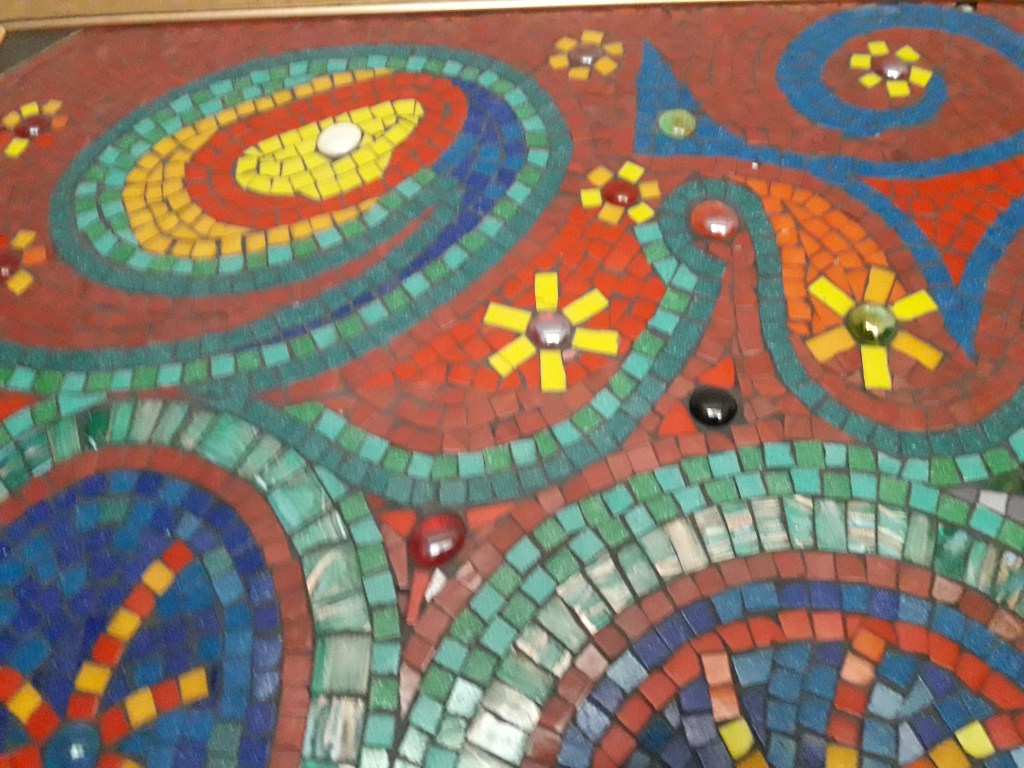
Phosphoros Mosaic Exhibition / Mozaik Sergisi

Gökşen Parlatan

Görsel

http://en.wikipedia.org/wiki/Phosphorus_(morning_star)

Phosphorus (Greek Φωσφόρος Phōsphoros), a name meaning “Light-Bringer”, is the Morning Star, the planet Venus in its morning appearance. Φαοσφόρος (Phaosphoros) and Φαεσφόρος (Phaesphoros) are forms of the same name in some Greek dialects.
Another Greek name for the Morning Star is Ἑωσφόρος (Heōsphoros), which means “Dawn-Bringer”. The form Eosphorus is sometimes met in English, as if from Ἠωσφόρος (Ēōsphoros), which is not actually found in Greek literature,[1] but would be the form that Ἑωσφόρος would have in some dialects. As an adjective, the Greek word is applied in the sense of “light-bringing” to, for instance, the dawn, the god Dionysos, pine torches, the day; and in the sense of “torch-bearing” as an epithet of several god and goddesses, especially Hecate but also of Artemis/Diana and Hephaestus.[2]
The Latin word lucifer, corresponding to Greek φωσφόρος, was used as a name for the morning star and thus appeared in the Vulgate translation of the Hebrew word הֵילֵל (helel) – meaning Venus as the brilliant, bright or shining one – in Isaiah 14:12, where the Septuagint Greek version uses, not Φωσφόρος, but Ἑωσφόρος. As a translation of the same Hebrew word the King James Version gave “Lucifer”, a name often understood as a reference to Satan. Modern translations of the same passage render the Hebrew word instead as “morning star”, “daystar”, “shining one” or “shining star”. In Revelation 22:16, Jesus is referred to as the morning star, but not as lucifer in Latin, nor as φωσφόρος in the original Greek text, which instead has ὁ ἀστὴρ ὁ λαμπρὸς ὁ πρωϊνός, literally: the star the bright of the morning.

Amazing Güell Park Mosaics

My sister decided to go to Spain. And she visited Güell Park.

These photos are very close shots from the mosaics !GörselGörsel

GörselGörselGörselGörselGörselGörselGörselGörsel

Details from my mosaic works ! – Mozaik çalışmalarımdan detaylar !

Gökşen Parlatan

DSC_029400

1-Nuh’un Gemisi -Noah’s Ark

DSC_029100

2- Simurg ve Bilgelik Kitabı – Phoenix and the Book of Knowledge

DSC_027100

3- Kemancı – Fiddler

DSC_024800

4 – Poppies – Gelincikler

DSC_024700

5 – New Horizons – Yeni Ufuklar

DSC_02988

6 – Dayanışma – Solidarity

DSC_02922

7 – Snail – Salyangoz

DSC_02888

8 – Dünya Benim – World is Mine

DSC_02822

DSC_02777

9 – The Eggs – Yumurtalar

İstanbul'da Günbatımı

10 – İstanbul’da Günbatımı – Sunset In Istanbul

DSC_02555

11 – Bir Yıldızın Doğuşu Birth Of A Star

DSC_02599

12 – The Goddess İsis –  Tanrıça İsis

DSC_02700

13 – Kalpten Kalbe – A Way Through Amazement

DSC_0273314 – Senin Şehrin – Your City

Highlights from the exhibition – Sergiden Kareler

DSC_01500 DSC_01588 - Kopya DSC_020600 DSC_02122 DSC_02233 DSC_02322 DSC_015500 DSC_02099 DSC_01888 DSC_01755 acayyip şekil - inappropriate mold

Back to the future – Geleceğe Dönüş

It’s in your fate – mosaic artwork

it's your fate

DSCN0009

It’s your fate – Kaderinde var
January 2013
Door handle,keys,beads,mirror,stained glass on mdf

Dallas Museum Volunteers to Return Mosaic to Turkey

The mosaic is to be returned to Turkey.Dallas Museum of Art The mosaic is to be returned to Turkey.

The Dallas Museum of Art voluntarily returned an ancient marble mosaic in its collection to Turkey on Monday, after determining that the work — which dates from A.D. 194 and shows Orpheus taming animals with his lyre — was probably stolen years ago from a Turkish archaeological site.

The decision, part of a new plan by the museum to court exchange agreements with foreign institutions more actively, comes at a time when the Turkish government has become more aggressive in seeking antiquities it believes were looted from its soil. In recent months it has pressed the Metropolitan Museum of Art and several other museums around the world to return objects and, to increase its leverage, it has refused loan requests to some.

The Met says that the objects sought by Turkey were legally acquired in the European antiquities market in the 1960s before being donated to the museum in 1989.

Other museums have accused Turkey of undue intimidation. Last year the Pergamon Museum in Berlin returned a 3,000-year-old sphinx, which Turkey said had been taken to Germany for restoration in 1917. But German officials say Turkey has continued to deny loans of objects for exhibitions because of claims to other objects in the Pergamon collection.

The Dallas mosaic, bought at auction at Christie’s in 1999 for $85,000, is thought to have once decorated the floor of a Roman building near Edessa, in what is now the area around the city of Sanliurfa in southeastern Turkey. Edessa developed alliances with Rome from the time of Pompey and was sacked under the rule of the emperor Trajan.

Maxwell L. Anderson, the director of the museum in Dallas, said that when he took over at the beginning of 2012, he asked antiquities curators to identify objects that might have provenance problems.

“What I didn’t want to happen here was a succession of slow-motion claims coming at us,” he said in an interview. As part of the review, the museum has also transferred legal ownership of several objects to Italy, including a pair of Etruscan shields and three kraters, or earthenware vessels used to mix wine and water.

Turkish officials had been searching for the Orpheus mosaic for some time, Mr. Anderson said. “For whatever reason, they hadn’t found their way to the Christie’s catalog or to us,” he said.

When the museum contacted Turkey earlier this year to say that it had doubts about the mosaic, whose existence seems not to have been cited in publications before its inclusion in the Christie’s catalog, Turkish officials provided photographs of a looted site near Edessa whose physical characteristics closely matched those of the mosaic.

“I saw that, and even as a novice, I said: ‘Done,’ ” Mr. Anderson said.

Cemalettin Aydin, the consul general of Turkey in Houston, who along with other Turkish officials took possession of the mosaic at a ceremony in Dallas on Monday morning, said in prepared remarks that he applauded the museum’s “unwavering ethical stance.” He added that the restitution would lead to an active loan arrangement between Turkey and the Dallas museum. The museum has no Anatolian collection to speak of, and so the hope is that the agreement with Turkey will allow Dallas to organize ambitious exhibitions of work lent from that region.

The return of the mosaic is the first official act of the museum’s new international loan initiative, called DMX, which seeks agreements with foreign museums to share objects and to collaborate on conservation projects, exhibitions and educational programs.